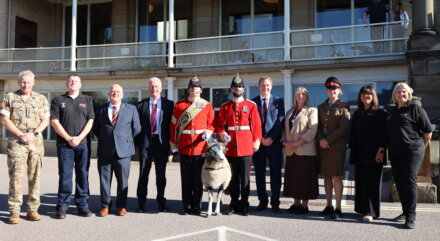
Employers have been warned that we are living in an increasingly dangerous world and that new partnerships between the military and industry are crucial to keeping the country safe.
Speaking at the 2025 Regional Engagement with Defence Conference, Stuart Williams OBE (pictured, above), Chief Executive of East Midlands Reserves and Cadets Association, made the stark warning off the back of the Strategic Defence Review’s release.
Touching on the war in Ukraine, growing Russian aggression, nuclear risks and daily cyber-attacks at home, he said, “the world has changed.”
Drawing on material from the review, he added: “We are in a new era of threat, but the Strategic Defence Review will make Britain safer, secure at home and abroad.
“Defence is fundamentally important to us al,l and a new mindset is needed to help us move to a whole of society approach to Defence. Key to that is a new partnership between Defence and industry.”
Businesses were also reminded of the value of employing military personnel – many bring desirable qualifications in areas such as leadership, advanced driving, and engineering – and were provided with an update on new ‘zig-zag’ career and skills passport initiatives.

Strategic Defence Review
The tone of the Regional Engagement with Defence on 12th June was set 10 days earlier with the release of the Strategic Defence Review.
Within the review, Prime Minister Sir Keir Starmer identified the importance of business as he laid out a ‘whole of society’ approach and ‘engine for growth’ as two of the review’s five core ambitions.
He wrote: “…we must drive a new partnership with industry and a radical reform of procurement, creating jobs, wealth, and opportunity in every corner of our country – this is the ‘Defence dividend’ which we are determined to seize.
“And it must foster a collective national endeavour through which the state, business, and society unite in pursuit of the security of the nation and the prosperity of its people.”
Hosted in Nottingham, the Regional Engagement with Defence Conference highlighted what the review means for business while providing updates on the broader landscape with a packed programme of military and business speakers.
Importance of Reserves
A key theme was the need for greater employer support for our Reserve Forces, which consists of people who train with the Royal Navy, Royal Marines, British Army or Royal Air Force alongside their day-to-day jobs.
Dubbed ‘twice the citizen’ by Winston Churchill, Reservists are paid to train in their spare time, combining part-time military commitments with their regular day-to-day work and life. The typical commitment is 27 days a year, spread across evenings, weekends and training weeks.
There are currently around 30,000 Reservists in the UK, but the Strategic Defence Review has set out an ambition to increase this force by 20% when funding allows.
The review also detailed plans to re-invigorate the ‘Strategic Reserve’, which primarily consists of former ‘Regular’ personnel who can be recalled in the case of national emergencies.
Addressing the audience, Group Captain Simon Briggs, Assistant Head, Reserves Employer & External Engagement, the Ministry of Defence, said: “At any one time, we have over 10% of the Reserve Forces supporting operations across 20 countries across five continents. Without those Reservists, we could not conduct operations and exercises.”
These operations include Operation Interflex, the British-led military operation to train and support the Ukrainian military and Operation Shader, the ongoing operation in Iraq and Syria to support the international coalition against terrorism.

He added: “So, from me, a thank you for what you’re doing. Without you, we seriously could not do what we do.”
Supportive employers – who offer additional paid leave and flexibility to accommodate Reservists’ training programmes – are a cornerstone of our Reserve Forces, and they are celebrated for their efforts through the Defence Employer Recognition Scheme.
As part of their mutually beneficial relationship, we estimate that, over their time with the Ministry of Defence, Reservists receive training that would cost an organisation between £10,000 and £18,000 to replicate.
An ability to remain calm under pressure, to lead a team through tricky situations, or even specialist skills like HGV driving or catering are all things learnt during service that can prove to be significant assets to employers.
By earning either the Bronze, Silver or Gold Award in the Employer Recognition Scheme, businesses are publicly celebrated for their commitments and invited to exclusive military events and training opportunities. They can also use the highly recognisable Scheme badge in their recruitment.
Recent changes rolled out alongside the Strategic Defence Review have placed greater importance on employers working in the engineering, manufacturing, Defence, technology, medical, space, cyber, digital, and drone sectors.
Looking ahead, Group Captain Briggs shared Ministry of Defence plans to encourage more ‘zig-zag’ careers, in which individuals move between different roles, industries, and even job functions over the course of their careers.
This is to attract better talent seeking more non-linear routes, which also benefits the Reserve Forces, as they greatly benefit from the diversity of knowledge, skills, experience, and behaviours that Reserves bring from their outside jobs.
The idea of a ‘skills passport’ is another initiative being carried forward by the department to help civilian employers of Reserves better understand the value-adding skills their staff bring to the table.
Toyota, one of the biggest employers in the East Midlands and a major employer of Reservists, Service-Leavers, Cadet Volunteers and Military Spouses, also took to the stage to detail what it does for Defence and why.
Talks from Commander Tim Green, Naval Regional Commander for London and Eastern England, and Fred Hopkins, Head of Engagement at the East Midlands Reserve Forces and Cadets Association, completed the programme.

Procurement and promotion
Elsewhere in the Strategic Defence Review, there were two other key areas concerning business.
The first centred on the need to strengthen our Defence sector, prioritising UK businesses to spread prosperity while also giving our Armed Forces more certainty and stability so they can scale in times of need.
Lessons have been learnt from the Russian invasion of Ukraine, which has demonstrated that a nation’s Armed Forces are only as strong as the industry, innovators, and investors that stand behind them.
The need for supporters to build society’s understanding of what our Armed Forces do and increase their visibility was another key theme – and the conference’s programme aimed to inform and empower the delegates to continue advocating for Defence.
Closing out the conference, Stuart Williams said: “This is our second Regional Engagement with Defence, and I want to say thank you for your support today and, more importantly, for all that you have done in the last 12 months and continue to do for Defence. It is arguably more important today than it was 12 months ago.”
South Kesteven District Council gathers local businesses for military skills symposium